
CDISC Releases ISF Reference Model v1: What It Means for Sites and Sponsors
A Long-Needed Standard for Site Documentation
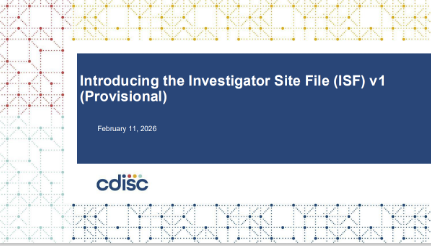
On 11 February 2026, CDISC released version 1 of the Investigator Site File (ISF) Reference Model. For the first time, theindustry has a structured framework for how investigator sites should organise and file their essential trial documents.
Why is there a new ISF Reference Model?
Until now, site documentation has been inconsistent. Different sites, institutions and even studies within the same organisation have used their own folder structures, file names and local rules for what the “official” ISF looks like. This inconsistency complicates sponsor–site reconciliation, increases inspection risk, and creates challenges when staff turnover occurs.
ISF v1 aims to:
- Establish structural consistency across sites
- Improve alignment between ISF and TMF documentation
- Reduce ambiguity in how essential records are organised
- Strengthen lifecycle management and inspection readiness
Of course, publishing a model is one thing, achieving adoption across the global site landscape is another. Investigator sites are not a homogeneous group. They range from large academic medical centres to smaller regional hospitals and independent research units, each with different systems, resources, and levels of digital maturity.
That diversity makes implementation one of the biggest challenges ahead. CDISC appears to recognise this. By aligning ISF v1 with the TMF Reference Model and signalling ongoing governance, training, and iteration, CDISC is actively driving adoption rather than leaving the model to passive uptake. That stewardship will be critical if consistency is to move from theory into practice.
What does ISF V1 introduce?
ISF v1 addresses this by introducing a defined structure comprising 14 zones and 126 artifacts, including 89 designated as core. It also maps ISF artifacts to TMF artifact groups, helping establish clearer structural relationships between site and sponsor documentation.
The objective is “consistency”. By defining how essential records should be organised, the model reduces ambiguity in filing and creates a more predictable framework for managing site records.
Importantly, the model is designed to operate across paper, electronic, and hybrid environments; this reflects the reality that many investigator sites continue to work across mixed systems as digital adoption progresses.
What is the immediate operational impact?
A consistent structure supports more accurate site-level organisation, simplifies onboarding for new staff, and makes sponsor reconciliation more efficient. Inspectors, in turn, can navigate records without first having to understand a site-specific filing logic.
To sum this up, ISF v1 aims to make essential record management more systematic and less dependent on local convention.
Why structure matters long-term
Retention and archiving only work when you can reliably identify and classify records. When files are scattered across binders, drives, local apps and portals, institutional knowledge lives in people and when those people leave, the organisation loses that knowledge. ISF v1 encourages discipline at the point of creation, which makes later migration, retention decisions and demonstrating completeness much easier. Standardisation doesn’t solve every preservation problem on its own, but it gives organisations a far more stable foundation to build on.
An Evolving Framework
CDISC mentioned in their webinar that the ISF model will be supported by implementation guidance, further training, and integration with the TMF Standard Model, with a v2 planned for 2027. This shows that ISF standardisation is not a one-time publication, but part of an evolving governance framework.
For sites, ISF v1 supports compliance and inspection readiness. For sponsors, it offers clearer alignment between TMF and ISF. For the broader clinical research ecosystem, it represents another step towards harmonised, lifecycle-based management of essential records.

Anthony Wells
Anthony assumed the role of Product Marketing Manager at Arkivum in 2024, leveraging over a decade of experience of product marketing management in the technology sector. Proficient in developing and executing marketing strategies, Anthony is also experienced in product lifecycle management, from inception through to discontinuation.
Get in touch
Interested in finding out more? Click the link below to arrange a time with one of our experienced team members.
Book a demo